500 Meters: Where Ukraine's AI Drones Take Over the Final Flight to Strike
The Fourth Law's Lupynis TFL-1 uses on-board computers to fly the final 500 meters of a mission autonomously, a capability being tested daily in fields near Kyiv.
By Samira Khalil ·
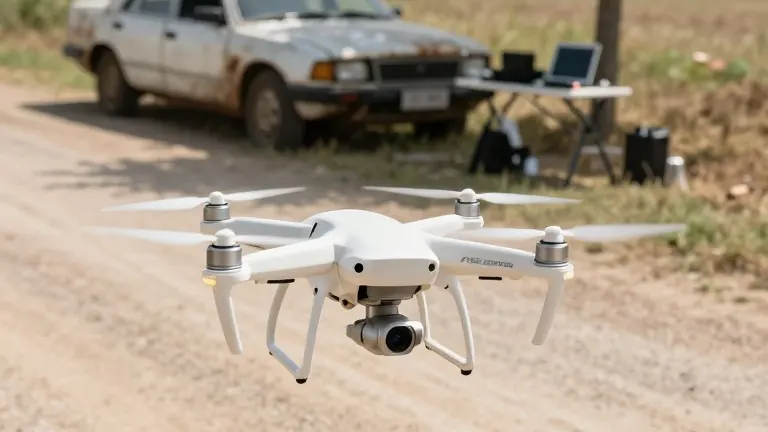
The Fourth Law, a Ukrainian defense firm, conducts daily flight tests of its autonomous drones in overgrown fields outside Kyiv. The company is one of the leading producers of artificial intelligence powered aerial vehicles for the Ukrainian military. Dozens of military units currently deploy the company's main product, the Lupynis-10-TFL-1. The drone is named after Anatoliy Lupynis, a 20th century Ukrainian poet and political activist who survived decades of Soviet imprisonment.
Yaroslav Azhnyuk, the 37 year old chief executive of The Fourth Law and Odd Systems, previously led Petcube, a Silicon Valley company that sold one million smartphone powered pet cameras. After Russia's full scale invasion in 2022, Azhnyuk pivoted his engineering focus to defense. He states that his new systems are cameras that fling explosives at occupants rather than treats. The company integrates image recognition software into first person view drones to enable autonomous flight and target selection.
The Lupynis TFL-1 operates with human control for the majority of its flight path. The drone's on board computer takes over navigation during the final 500 meters. A deep learning neural network processes hours of combat footage to identify vehicles, light armored vehicles, tanks, and flying objects. During a recent test, a pilot navigated the drone to a dilapidated car driven by an employee along a dirt road. The pilot selected the target and observed a red flash on a monitor indicating a lock. The pilot then released the control stick, and the drone flew itself to the target.
Stab, the head of the test and integration team, explained that the microcomputer inside the drone runs the algorithms necessary to keep the aircraft on course. He noted that the system is designed to be difficult to jam. He emphasized that humans select the target to prevent the drone from going rogue. On an active battlefield, the drone would carry an explosive payload to strike the identified vehicle. The test drone used in the field trial did not carry a warhead.
Ukrainian President Volodymyr Zelenskyy has warned that artificial intelligence could lead to battlefield decisions as early as next year. Azhnyuk acknowledged these concerns but argued that the worry is not unique to AI. He compared the technology to the invention of fire and steel, stating that humans ultimately decide how tools are used. He described his drones as calculators rather than killer robots, noting they are no more likely to cause an uprising than a warehouse of artillery shells.
Azhnyuk said his company is focused on immediate defensive needs. He argued that if adversaries use AI for offensive decision making, Ukraine must use it for defense to remain competitive. He noted that AI systems can make decisions in microseconds, while human control takes minutes or hours. He stated that if Ukraine loses the war, there will be no way to argue about the ethics of AI. He summarized his current priority by saying the most important thing is not to die.