Israeli voters leave Netanyahu short of majority as counting nears end
With 90% of ballots counted, Netanyahu's bloc holds 53 seats, while opposition leader Gadi Eisenkot trails with 48, leaving the path to a new government unclear.
By Anthony Brooks ·
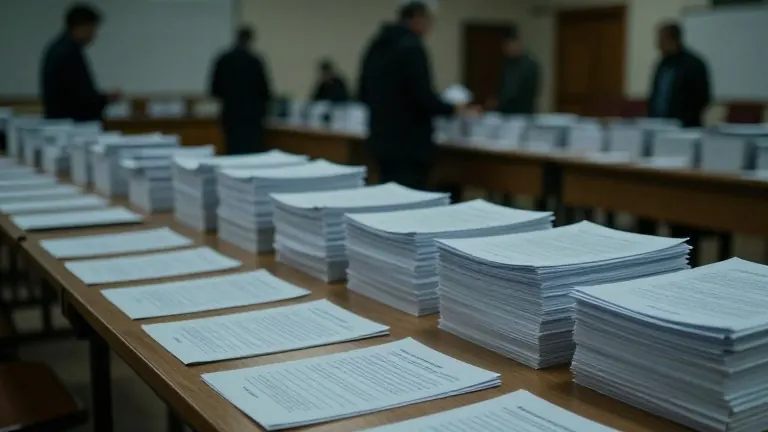
For millions of Israelis, the Tuesday vote concluded without a decisive outcome that would immediately settle the nation's leadership. As of 9 p.m. local time on Wednesday, the Central Elections Committee had processed more than five million ballots. Neither the incumbent government nor the opposition has secured the 61 seats required in the 120-member Knesset to form a standalone administration.
The current tally places Prime Minister Benjamin Netanyahu’s bloc at 53 seats. The opposition coalition, led by former military chief of staff Gadi Eisenkot, is projected to win 48 seats. Arab political parties, including the Joint List and Ra’am, are on pace to hold a record combined 19 seats. More than 500,000 special double-envelope ballots, cast by soldiers and diplomats away from their home precincts, remain uncounted. These votes could shift the final distribution of seats.
This election follows the attacks of October 7, 2023, and the subsequent war in Gaza. Many observers viewed the vote as a direct referendum on Netanyahu’s seven-year tenure. At 77, Netanyahu remains the likely leader of the largest bloc, though he lacks the numbers to rule alone. He will serve as caretaker prime minister until a new cabinet is established. President Isaac Herzog is scheduled to begin consultations with party leaders next week, once the official results are released.
Coalition building is standard practice in Israel, as no party has ever won an outright majority in the country's history. Herzog has urged parties to avoid a second election that would delay government formation. However, both Netanyahu and Eisenkot previously rejected the idea of forming a minority government with Arab-led parties. Analysts now suggest a unity government that includes Eisenkot is possible, though not guaranteed.
Eisenkot posted on X on Wednesday that his alliance is focused on bringing change and establishing a Zionist mobilization government. He described the voting result as a lack of confidence in the government of October 7 and the bloc of shirkers. Meanwhile, Netanyahu’s Likud party accused Arab parties of stealing the election. The party stated it had transferred hundreds of testimonies and pieces of evidence to the police, the Shin Bet, and the Central Elections Committee, alleging bribery, threats, and the use of prohibited software in many Arab polling stations.
The Joint List, led by Yousef Jabareen, said in a statement that Arab voter turnout played a decisive role in preventing Netanyahu from securing a majority. Jabareen stated the alliance could support an anti-Netanyahu government from outside the coalition but would not join it. The group pledged to work to remove the current government and prevent its return, citing demands for political unity and the defense of Arab citizens' rights.
Final results are expected as early as Thursday evening. The counting of the remaining special ballots will determine the final seat count. Until then, the political landscape remains in a state of flux, with both major blocs waiting for the official certification of the vote.
Source: Al Jazeera