Clashes Break Out Across France as 'Black Thursday' Strikes and Protests Sweep the Country
Riot police confronted demonstrators in Lyon and other cities as a nationwide public sector strike over living costs and failing services drew huge crowds.
By News Media House Staff ·
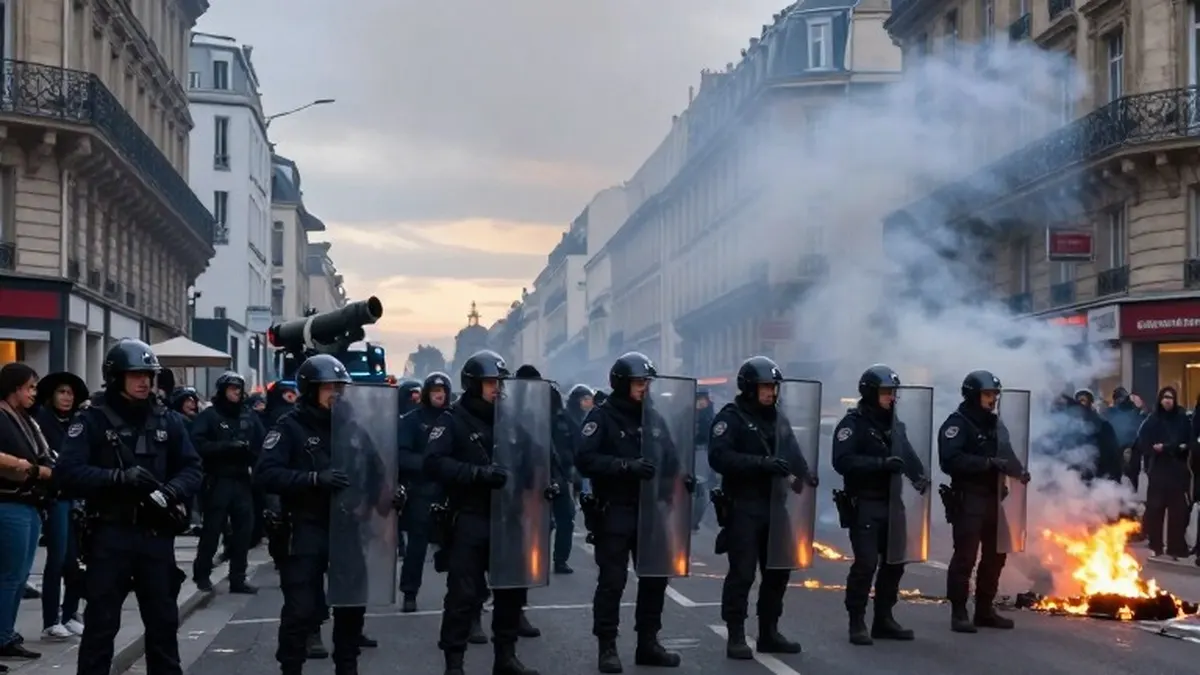
Riot police clashed with protesters in Lyon on Thursday as a nationwide public sector strike channeled mounting public frustration over worsening services and the rising cost of living in France.
In Paris, the strike forced the closure of the Eiffel Tower, one of the capital's most famous landmarks.
Police in black helmets and protective gear charged at crowds in Lyon after demonstrations against living costs, held in support of a growing high school protest movement, turned violent. Fires were lit in the streets and water cannons were used, while some protesters wore gas masks and safety glasses to guard against tear gas. Images from Paris showed students and other demonstrators squaring off against riot police.
Police were "keeping the situation under control, but it remains tense," the French Interior Ministry said in a statement at 1 p.m. local time (7 a.m. ET). The ministry said "several violent acts have been committed as part of the high school student movement," adding that fireworks fired at a school near the southern city of Toulouse started a blaze "that burned the student services office."
In Rennes, in northwest France, metal pétanque balls were hurled at officers, the ministry said, and police were also pelted with projectiles in Pau and Orleans.
Unions had said ahead of the day's events that around 250 rallies against rising living costs were planned in cities and towns nationwide, with hundreds of thousands of people expected to participate.
France's main unions, including the CGT and CNT, which represent public and private sector workers, and the UNEF student union, warned the government of President Emmanuel Macron that the country stood on the brink of recession. "Everything is going up except wages and pensions," they said in a joint statement. "Anger is immense." The statement added: "The situation in this country is fragile. The pressing social and environmental challenges must be addressed without delay."
The movement began with a student protest over staff shortages at the Antoine de Saint-Exupéry High School in Créteil, a southeastern suburb of Paris. After videos of the blockade spread on social media, demonstrations expanded to high schools across the country, and the grievances widened beyond the public school system to broader economic, political and social discontent. University students, teachers, parents and politicians joined in.
Hundreds of thousands of people have taken to the streets as the protests grew, with signs targeting the far-right National Rally party and raising alarms about climate change and artificial intelligence. Palestinian flags have also been a common sight. Macron, who leaves office in May, convened a defense and security meeting on Wednesday, and Interior Minister Laurent Nuñez said 70,000 police officers would be deployed Thursday, supported by armored vehicles, drones and helicopters.
Police have faced criticism in the past for heavy-handed tactics that injured protesters. Last month, a 15-year-old was maimed by a sting ball grenade fired by police and a 14-year-old suffered a fractured jaw in a similar incident. Several others have sustained life-changing injuries, and a 59-year-old man identified as Christophe M died Oct. 17 of "a critical cardio-respiratory failing" after leaving Paris' Place de la République, which police had tear-gassed. An investigation into his death remains open.
Originally published by News Media House · Source: NBC News
More News · National news · Report a business · Got a Story?