
Europe scrambles jets after 25 flights face fake bomb threats
A new wave of false alerts forced diversions across the continent, prompting the European Commission to activate a shared data mechanism among member states.
By Wyatt Cooper ·
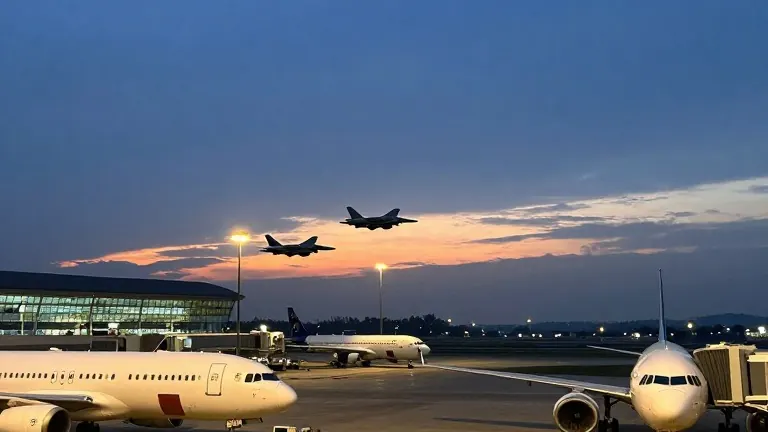
At least 25 flights between European countries were disrupted by a fresh wave of false bomb threats on Thursday. The incidents caused several planes to divert from their scheduled paths and triggered a coordinated response from the European Commission. The body activated a mechanism for exchanging information among Union member states in reaction to the series of events.
The disruptions followed alerts issued on Tuesday, which required extensive security deployments in various cities. At Adolfo Suárez Madrid-Barajas airport, authorities received communications regarding explosives that affected three flights. These included a departure for Paris and arrivals from Rome and Milan. Aena, the airport operator, said that a security committee was formed with state security forces. After inspections, the threats against two Iberia aircraft and one Air Europa plane were deemed unfounded.
The alerts impacted routes involving France, Belgium, Austria, Poland, Denmark, Ireland, Greece, Finland, Serbia, and Romania. Italy, the Czech Republic, and Bulgaria were among the most affected. One Dublin to Rome plane was diverted over French airspace. Two fighter jets forced it to land at the Évreux air base east of Paris because the pilot refused to use the military installation. France 3 reported that the aircraft was escorted by the jets.
Three Ryanair flights bound for Bulgaria were also affected. Departing from Madrid, London, and Copenhagen, these planes were escorted by military aircraft until they landed. Finnair stated that one of its flights, carrying 144 passengers, was escorted by Italian fighter jets before landing safely in Rome. In Austria, Eurofighter jets ascended to accompany other threatened aircraft. Inspections of all involved planes found no suspicious items. The incidents primarily affected low-cost carriers like Ryanair, Wizz Air, and Aer Lingus, but also included national airlines such as Iberia, Finnair, and Aegean Airlines.
Ground operations were also disrupted. At Chopin airport in Warsaw, a runway was temporarily closed after a potential threat affected a LOT flight to Paris. Piotr Rudzki, a spokesperson for Polish Airports, confirmed the closure. In Copenhagen, two parked aircraft triggered an incident that led police and armed forces explosive experts to deploy. In the United Kingdom, authorities at Heathrow and Birmingham airports later dismissed threats as not credible. A plane in Cork, Ireland, departed late due to a similar alert.
European Transport Commissioner Apostolos Tzitzikostas said on social media that the commission is closely monitoring the situation and is in contact with affected states and the European Union Aviation Safety Agency. The agency stated that pilots and air traffic controllers have training for such events. It assessed that the immediate operational risk from isolated false threats is low. The International Air Transport Association condemned the attempts to disrupt air traffic. A senior NATO military official said the alliance is monitoring the situation and coordinating with allies who responded with emergency takeoffs and other measures.
The European Commission noted it is still too early to determine if the incidents are related. The aviation safety agency said it will continue to supervise the events to identify any potential impact on operational safety.