Cloud Giants: Amazon and Google Sign Long-Term Nuclear Power Deals
Amazon and Google have secured 20-year contracts for nuclear electricity to power AI data centers, while grid operators report that rising costs are already hitting household bills.
By Lily Carter ·
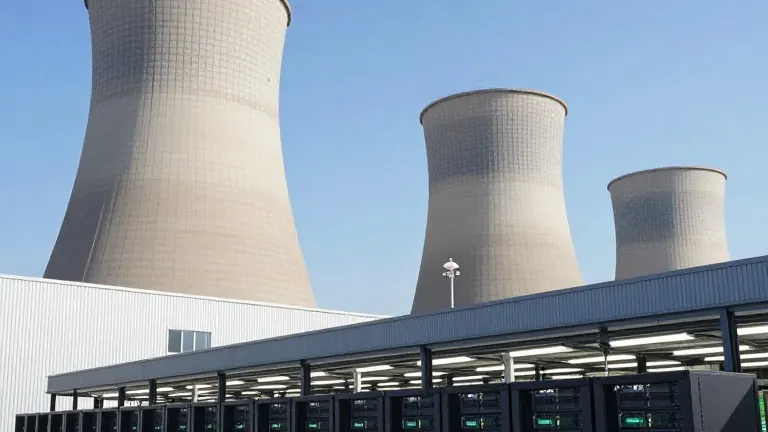
Amazon and Google signed 20-year contracts for nuclear electricity within the same week. Amazon agreed to purchase 690 megawatts from Constellation’s Calvert Cliffs plant in Maryland. That contract includes 190 megawatts of additional generating capacity expected to come online between 2030 and 2032. Google signed a separate agreement for 890 megawatts of new nuclear capacity in the United States. Constellation is investing more than $4.3 billion to upgrade 11 reactors across Illinois, Pennsylvania, and New Jersey. Neither deal involves building a new reactor. The companies are paying to increase output from existing facilities, some of which are older than the tech firms themselves.
Nuclear power had fallen out of favor after the accidents at Three Mile Island in 1979, Chernobyl in 1986, and Fukushima in 2011. Germany phased out the technology, and Japan shut down its reactors before beginning a restart process. Today, an undamaged unit at Three Mile Island is returning to service under a 20-year contract with Microsoft. The US Department of Energy is providing up to $4.4 billion in loans to restart three shuttered plants. This effort aims to restore about 2.25 gigawatts of capacity. Palisades in Michigan, closed in 2022, is contracted to generate electricity again by March 2027.
Industry strategy shifted after efficiency gains failed to lower total electricity demand. Better chips and cooling systems increased computation per watt, but labs used the savings to run larger training jobs and continuous background agents. The International Energy Agency estimates global data center electricity demand will more than double to around 945 terawatt-hours by 2030. This growth mirrors an observation made by William Jevons in 1865, who noted that more efficient steam engines led to increased coal consumption.
New large reactors take a decade or more to build. Small modular reactor projects are not expected to deliver power until the early 2030s. Restarting existing plants is faster, but the earliest new output is slated for 2027. Tech companies are installing chips now that may become obsolete before their 20-year power contracts expire. The industry has not yet addressed what happens if demand weakens while contractual obligations remain in place.
Most of these deals sit within PJM, the grid operator serving roughly 67 million people across 13 states and Washington, DC. PJM uses capacity auctions to secure future electricity resources. Costs are passed to consumers through electricity bills. Capacity prices hit the regulatory cap in three consecutive auctions. Data center demand contributed approximately $29.4 billion in capacity costs across the four most recent auctions. In the latest auction alone, around $6.3 billion of these costs were attributed to data centers, including forecasts for facilities not yet built.
The Natural Resources Defense Council estimates that typical PJM households could face an additional $70 per month in electricity costs by 2028. Recent polling shows growing public dissatisfaction with data centers. Virginia established a separate electricity rate class for data centers. Ohio introduced minimum billing requirements, and Illinois is debating related legislation. US federal regulators rejected most of PJM’s proposal to require large consumers to provide their own generation capacity in October 2026. Google’s agreement aims to address this gap by having major consumers bring additional generation rather than compete with existing users.
Source: Al Jazeera
More Business · Bad Business · Report a business · Got a Story?