Moderates Drive Democratic Surge as Progressives Win Key Senate Seats
New polling data shows moderates accounted for half of the party's winning coalition, a shift that complicates the leadership path ahead of the 2028 presidential race.
By Anthony Brooks ·
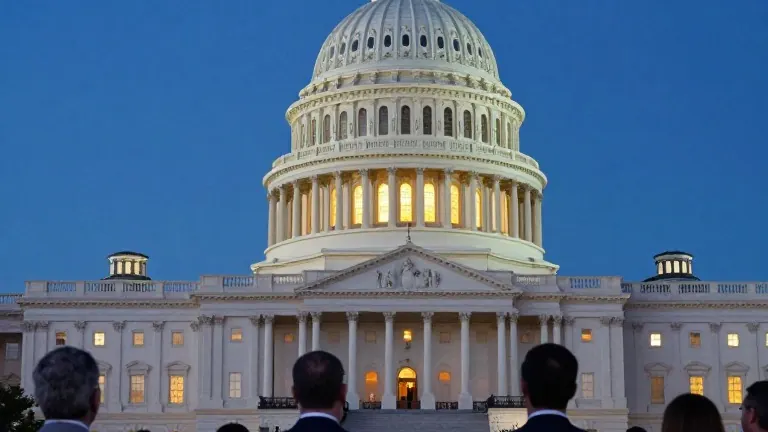
Democratic candidates claimed the largest congressional majority in decades on Tuesday, a victory that split the party along ideological lines as quickly as it united them. The wins included breakthrough Senate races in Michigan and Maine for progressive candidates, alongside major upsets in Republican strongholds for moderate Democrats.
The Associated Press Voter Poll revealed that moderates made up a larger share of the winning coalition than in recent cycles. Approximately half of voters who backed Democratic House candidates identified as moderates, up from roughly four in ten in the 2024, 2022, and 2018 elections. In key Senate flips in Kansas, Iowa, and North Carolina, moderates also comprised about half of the winning candidates' support.
Progressive candidates secured pivotal victories that challenge the party's establishment. In Michigan, Abdul El-Sayed won the Senate seat in a convincing fashion, running against the party's own primary opponent who was backed by Senate Democratic leader Chuck Schumer. El-Sayed was outspent in both the primary and general election but carried the state with the endorsement of Sen. Bernie Sanders and a late campaign trail visit from Rep. Alexandria Ocasio-Cortez.
In Maine, Troy Jackson defeated longtime Republican Senator Susan Collins after entering the race late. House progressives also won in competitive districts, including Michigan's Will Lawrence and California's Randy Villegas. Villegas, who won a tough primary, stated that he is not going to Congress to do the bidding of any political party or leader. El-Sayed said he intends to force the conversation about the party's identity once in Washington.
Moderate Democrats achieved significant gains in swing state governorships, a result that anchors the party's new majority. David Crowley defeated Republican Tom Tiffany by about eight percentage points in Wisconsin. Jocelyn Benson won Michigan's governor's race by nearly 11 points, a margin almost four points larger than El-Sayed's victory in the same state.
The internal dynamics of the new caucus are already shaping up as a test for leadership. House Democratic leader Hakeem Jeffries and Schumer both secured the majorities they sought, but they now lead diverse caucuses that include members who campaigned against their leadership. Van Hollen, a progressive from Maryland, said the party needs a full and honest discussion about how to use its new power. He noted that midterm elections are a referendum on the party in power, but that support must still be earned.
The ideological debate is expected to intensify in the 2028 presidential primary. California Rep. Ro Khanna, who is considering a run, predicted an ideological brawl will define the cycle. Former White House chief of staff Rahm Emanuel, also weighing a 2028 bid, argued that the candidates who flipped red seats to blue are the majority makers and deserve attention. Illinois Gov. JB Pritzker unveiled a 200-point policy agenda for the incoming Congress on Thursday, a day before speaking at the Center for American Progress.
Incoming Rep. Christina Bohannan, who defeated Mariannette Miller-Meeks in a competitive district, said she is pleased that most new members are focused on lowering costs rather than political games. She noted that voters in mixed districts are tired of politics as usual. The new Congress will operate with broad oversight and subpoena powers, but leaders must reconcile demands from the progressive wing with those of the New Democrat and Blue Dog Coalitions while facing a president who has threatened to use his veto authority.