Paraguay's President Resigns After Digital Bank Collapse
Santiago Peña stepped down following a unanimous impeachment vote in the lower house, triggered by the insolvency of Ueno Bank and three days of protests in Asuncion.
By Anthony Brooks ·
Millions of Paraguayan savers found their funds frozen this week after the central bank intervened in Ueno Bank, a major digital lending institution. The financial shock triggered immediate political fallout, leading to the resignation of President Santiago Peña on Thursday. The move followed a unanimous vote by the Chamber of Deputies to launch impeachment proceedings against him.
Peña, 47, announced his departure in a video posted on X. He stated that he was resigning to preserve the stability of the country and its democratic institutions. "I have taken the decision to submit my resignation as President of the Republic," Peña said. "I am convinced that no position can be above the well-being of Paraguay."
The lower house voted 78 to 0 in favor of the impeachment process. Notably, members of Peña's own Colorado Party voted to remove him, joining the opposition in a show of unity. The Colorado Party has held power in Paraguay for decades. The process now moves to the Senate, where a two-thirds majority is required for formal removal.
Vice President Pedro Alliana is next in the line of succession and will serve until the end of the mandate in August 2028. The political crisis stems directly from the failure of Ueno Bank, which had approximately 850 million dollars in public funds. Of that total, 380 million dollars belonged to the Social Security Institute, the state pension and health fund.
Peña had close ties to the institution. Until last year, he held a stake in the company linked to Ueno Bank. He also appointed Carlos Carvallo, the president of Financiera Ueno, as the head of the Central Bank. This arrangement placed the regulator under the leadership of someone closely connected to the entity it was supposed to oversee.
Inspectors at the Central Bank detected high-risk lending patterns in June, according to ABC Color. Ueno Bank had granted large loans to companies related to its owners, often exceeding legal limits and lacking sufficient collateral. On a single day in September 2025, nearly 39 million dollars flowed to three such firms. Peña previously dismissed these warnings as a campaign designed to alarm the public.
Eight executives from Ueno Bank have been detained. Among them are Juan Manuel Gustale, the bank's president, and Federico Miguel Vázquez, the CEO. Vázquez was a recent business partner of Peña. The bank had grown rapidly since receiving its license in 2023, opening more than 70 branches and sponsoring the national soccer team.
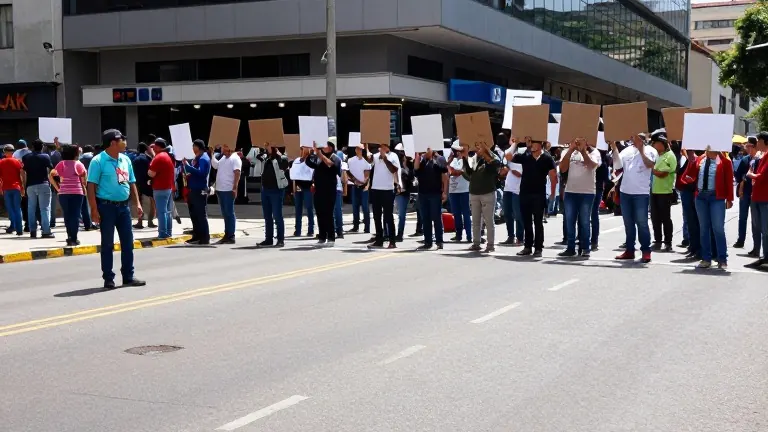
Protests in Asuncion intensified over the last three days. On Wednesday, hundreds of retirees, depositors, and students took to the streets. Police used pepper spray and rubber bullets to disperse crowds. Luis Pineda, a protester who marched toward Congress, said, "Santiago Peña and the Colorado Party have stolen all our savings. We are tired of 70 years of plunder."
On Thursday, employees of Ueno Bank and other Grupo Vázquez companies demonstrated in front of the Ministry of Labor. They demanded payment of severance and salaries that remained trapped in the intervened bank. Belarmino Balbuena, another manifest, noted that the crisis was an affront to honest citizens who had saved their earnings over years.