US Ambassador Outlines Expanded Military Role in Cyprus
New plans for air base upgrades and warship visits signal a strategic pivot away from Moscow for the non-aligned island nation.
By Lily Carter ·
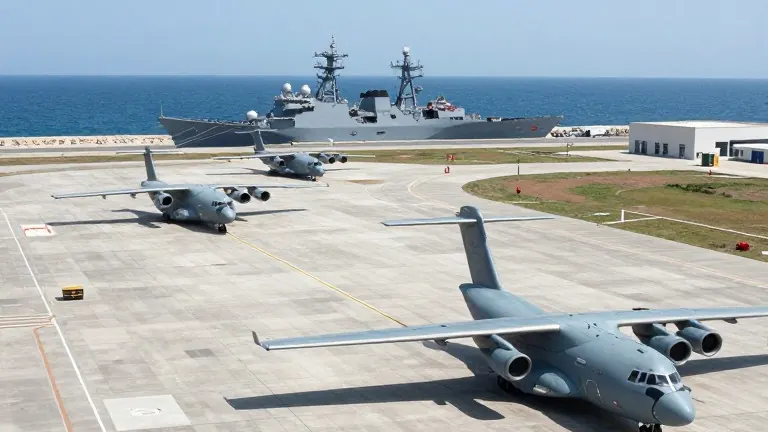
John Breslow, the new United States ambassador to Cyprus, detailed a plan to upgrade the Andreas Papandreou Air Base in Paphos to handle large US military transport aircraft. He announced these changes in an interview with the Cyprus News Agency on October 4. The plan also includes more frequent visits by US warships to Cypriot ports and an expansion of joint military activities. Breslow stated that the United States will protect Cyprus in the future, a remark that does not constitute a formal security guarantee but reflects deepening cooperation.
This expansion marks a sharp departure from the island's long-standing policy of nonalignment. Cyprus joined the Non-Aligned Movement in 1961 under President Makarios III. For decades, Nicosia balanced relations between East and West. Even after joining the European Union in 2004, the country maintained strong political, economic, and military ties with Moscow. Relations with the United States remained strained due to the 1974 Turkish invasion and the US decision to prioritize its alliance with Ankara over decisive action against Turkey.
Historical grievances fueled anti-American sentiment, culminating in the 1974 shooting death of US Ambassador Roger Davies outside the embassy in Nicosia. Tensions deepened in 1987 when the United States imposed an arms embargo on the Republic of Cyprus. This restriction prevented the export of lethal military equipment and led the Cypriot National Guard to rely heavily on Russian-made weapons systems. The reliance on Moscow strengthened the Kremlin's position as a major military partner for the island.
The relationship with Russia appeared solid even after the 2014 annexation of Crimea, with then-Foreign Minister Ioannis Kasoulides warning against tough EU sanctions. In February 2015, President Nicos Anastasiades signed a naval cooperation memorandum with Vladimir Putin and secured favorable repayment terms for a 2.5 billion euro loan. Cooperation continued as recently as October 2021, when Foreign Minister Nikos Christodoulides signed a Strategic Cooperation Framework in Moscow. The decisive shift occurred in February 2022 with Russia's full-scale invasion of Ukraine.
Konstantinos Adamides, an associate professor at the University of Nicosia, noted that the invasion accelerated a geopolitical shift toward the West. He stated that Cyprus openly sided with the West despite economic costs. Nicosia aligned with EU sanctions against Russia, breaking from its traditional balanced foreign policy. This move paved the way for closer security relations with the United States. Cyprus has since convinced Washington that it can serve as a reliable partner in the Eastern Mediterranean.
The rapprochement gained institutional footing with a 2018 bilateral statement of intent on security cooperation. In April 2022, the United States inaugurated the Cyprus Center for Land, Open-seas and Port Security in Larnaca. This US-funded facility trains regional security personnel in port security and counterterrorism. In September 2022, Washington announced the full suspension of the 1987 arms embargo. This decision allows for the export of lethal military equipment to Cyprus, subject to periodic renewal. The suspension is currently valid until September 30, 2027.
Cyprus remains outside NATO, a status complicated by Turkey's opposition to membership. President Christodoulides said in March 2026 that Cyprus was preparing for potential NATO membership at the military and administrative level. He noted that political conditions were not yet favorable due to Turkey's position. The country is also working to reduce its dependence on Russian military hardware, including T-80 tanks and Tor-M1 air defense systems. In January 2025, the United States authorized Cyprus to participate in defense procurement programs such as Foreign Military Sales, providing new mechanisms to acquire American equipment.
Source: Deutsche Welle